
Deuteronomy
the prophet as editor

Deuteronomy, the title of the last Book of Moses, comes from the Greek “Deuteronomion,” which means “second law.” The Greek is an erroneous translation of the Hebrew משנה התורה הזאת or mishneh hatorah hazzot, which means a copy, transcript, or repetition of the Torah. Historically, rabbis referred to Deuteronomy as Mishneh Torah, and in Maimonides’s Mishneh Torah, Maimonides draws from Deuteronomy more than any other book.
In many ways, Deuteronomy is a transcript of the four antecedent books. It recounts the main events of the wanderings of the Jews. It reviews the laws and commandments given to the Jews. It also adds some more. It even contains the Sh’ma, Judaism’s most central prayer, itself regarded as a distilled transcript of the Torah: “Hear, O Israel! The ETERNAL is our God, the ETERNAL alone” (Deuteronomy 6:4). Deuteronomy is distillation.
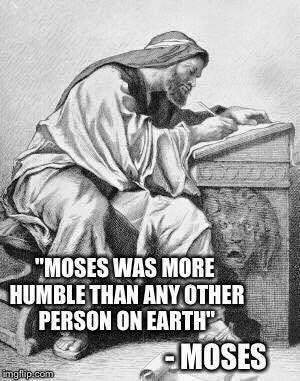
Moses is the narrator and undisputed hero of Deuteronomy. Much of the book is a series of speeches by Moses to the Jews, spoken in the first-person. If Deuteronomy is the Mishneh Torah of the Torah, it is appropriately the most Moses-heavy of the Books of Moses. And if Moses is the author of the Torah’s final transcript, he is also the Torah’s editor. It’s Moses who takes four books and turns them into one. I imagine him looking back on his writing and his life before picking up his pencil to start cutting entire plotlines. So much of the plot—not to mention the religion—centers on Moses’ life that the text and the man become nearly synonymous. In Deuteronomy, Moses faces the task of editing not just the material but also himself. Moses is the material.
With the power of deletion, Moses alters his story to omit moments when he relied on others, like the moment when his father-in-law, Jethro, inspired him to create the judicial system in Exodus, or the moment when Caleb stood up to cowardly scouts in Numbers. In Deuteronomy, Moses revises these stories such that it becomes his idea to form the judiciary, and his voice against the scouts’ cowardice. More than crediting himself with the work of others, Moses’ omissions also diminish the details of his personal life. In Deuteronomy, it’s as if Moses never had a father-in-law, and by extension, a marriage. Similarly, Moses’ siblings, Aaron and Miriam, do not feature prominently in Deuteronomy. Moses mentions Aaron’s involvement in the golden calf episode and the details of his death, but makes no mention of Aaron’s crucial role as Moses’ partner in leading the exodus. Every plotline cut by Moses’ pencil is a relationship severed and an identity—friend, brother, son-in-law—erased.
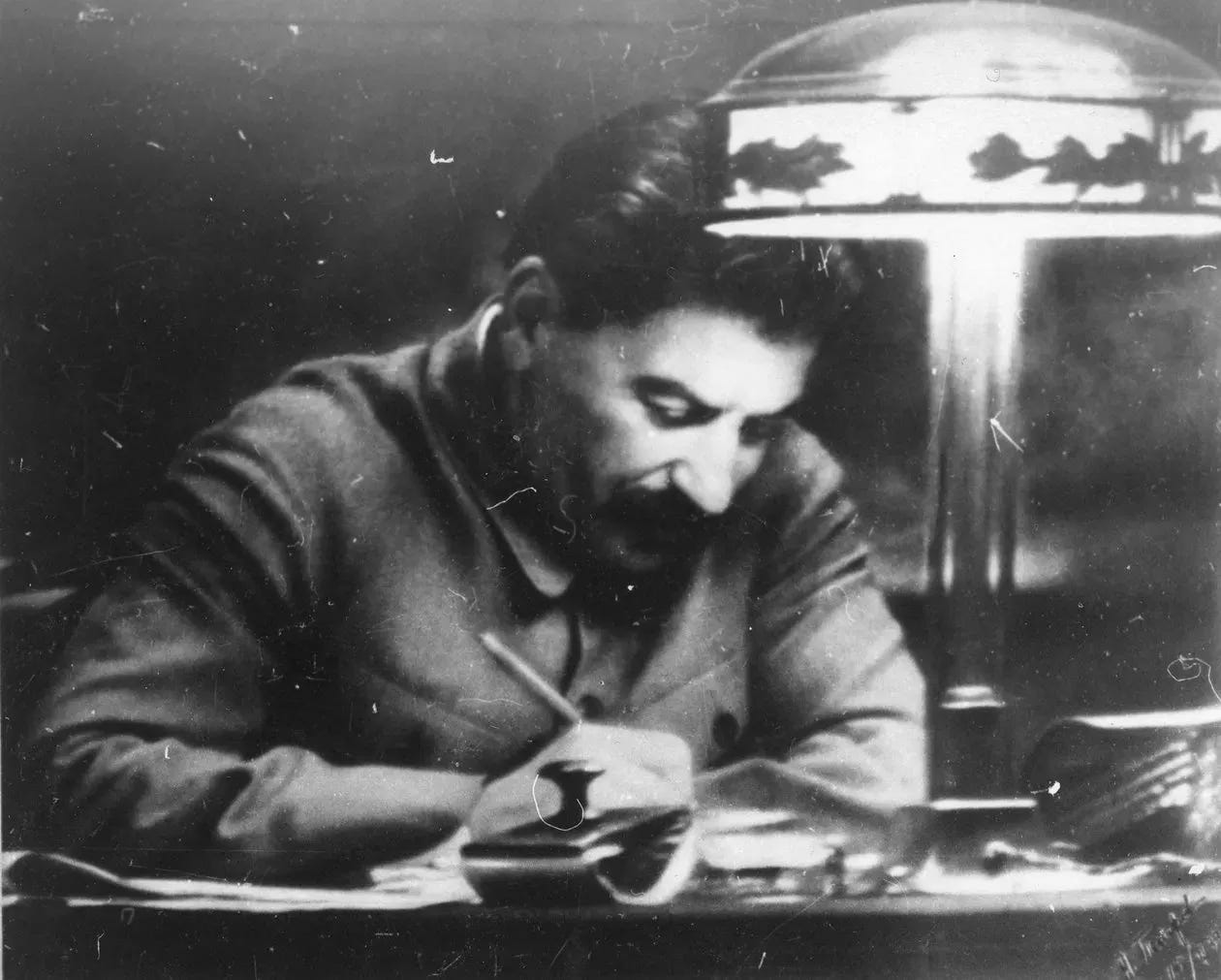
In her article “The Tyrant as Editor,” historian Holly Case paints an unexpected picture of Stalin as the talented and tenacious editor of the Communist Party’s publications, his own work, and his image. With a blue pencil, Stalin passed over memos and speeches, cutting, pasting, revising, and undoing previous edits. Stalin’s blue pencil was an extension of his iron fist; with it, he erased people from history, altered conversations, centered some ideas and diminished others. According to Case, Stalin often cut himself and his achievements out of manuscripts and always kept the details of his personal life out of the final drafts. “But we should not confuse Stalin’s self-effacement with modesty,” Case adds. “Though we tend to associate invisibility with the meek, there is a flip side that the graffiti artist Banksy understands better than most: ‘invisibility is a superpower.’” By destroying any evidence of a real man behind the blue pencil, Stalin’s edits would go undetected, seamlessly blending with the text. Further, by eliminating his person, Stalin could, and did, “transform himself into an idea and, ultimately, an ideology.”
Editing the self into a symbol demands a kind of prescience that recalls the biblical prophetic. It requires eyes that can read a text today, ten years later, and a century later, all at once. Moses the editor, like Stalin the editor, already saw himself through the bird’s-eye view of history, and his edits, like Stalin’s, secured him as a symbol to withstand the course of time. After all, prophecy is, colloquially, the ability to see into the future. It’s historically what has made Moses so uniquely useful to God and starkly isolated from his community. In the desert, when everyone else is blinded by their immediate circumstances, desires, and complaints, Moses keeps his bird’s eye fixed on the Jewish project, spanning geography and time.
Before Moses recounts the events at Mount Sinai and the delivery of the Ten Commandments, he says, “Take utmost care and watch yourselves scrupulously, so that you do not forget the things that you saw with your own eyes and so that they do not fade from your mind as long as you live. And make them known to your children and to your children’s children” (Deuteronomy 4:9). By this time, the generation of Jews present at Sinai is all but gone. Standing before Moses is the next generation, Jews who would have only heard about the covenant as children. Yet Moses urges them to remember, blending the memories of the collective and the individual, the previous generation and the current generation. He continues:
You came forward and stood at the foot of the mountain. The mountain was ablaze with flames to the very skies, dark with densest clouds. GOD spoke to you out of the fire; you heard the sound of words but perceived no shape—nothing but a voice…For your own sake, therefore, be most careful—since you saw no shape when GOD spoke to you at Horeb out of the fire—not to act wickedly and make for yourselves a sculptured image in any likeness whatever. Deuteronomy 4:11-4:16
Moses weaves words into memory, using God’s nebulous voice-without-form to impress monotheism upon the minds of his audience. The details, the form, do not matter as much as the message, the voice, the idea. Moses knows he will be immortalized in history, preserved as an idea synonymous with the exodus, the Decalogue, and monotheism. But with his immortality comes an inability to allow himself more ephemeral, mortal experiences and connections. Moses cannot mourn the deaths of individuals, even those of his nephews and siblings, because from his view on high, they are single lines in entire paragraphs and chapters. Moses the editor is the logical terminus of his evolution. After years of detachment from his people and himself, the editor—who must step outside himself, recognize himself, and revise himself—is Moses’ final form.
Image: Josef Stalin in his Kremlin study, Moscow, USSR, 1935.
That was pretty interesting. Thats the most I've ever thought about Deuteronomy ever.
Thank you as always for this insightful interpretation of Deuteronomy. I never knew it was a summary of the other books. I like your take on revisionist history -- I think we all do a bit of that and Moses was no different. Retelling the stories of history in a way that he saw fit.