
Genesis to Exodus
Gifted children and Jewish maturation

Note to my readers: I will not post essays for the next three weeks. This post will cover the events of parashot Va-yeishev, Mi-ketz, Va-yiggash, and Va-y’ḥi. My next post will be on January 12th for Sh’mot.
In this week’s parsha, Joseph is sold into slavery in Egypt by his brothers, setting the stage for his famed rise in the ranks of the house of Pharaoh, the movement of his family to Egypt, and, after many generations, the enslavement of their descendants, the Jewish people. The story of the Jews’ enslavement is typically understood as the first tragedy in a long and lachrymose history of Jewish suffering. We might interpret that story differently, however, if we use the individual story of Joseph as our interpretive guide to the larger story of the Jews. Dividing the story of Joseph into three phases—adolescence, maturation, and adulthood—we find an allegory of the growing-up of the Jewish people that occurs over the course of enslavement and emancipation, between Genesis and Exodus.
Like many teenagers, the adolescent Joseph is immensely gifted—and completely lacking in social awareness. One of twelve brothers, he is the favorite of his father Jacob and is singled out by God for great things. He is also blessed with prophetic dreams, much to the chagrin of his already-hateful brothers.
When Joseph begins to have dreams portending the subordination of his entire family to him, he openly and enthusiastically announces them to his family. It’s the last straw for his brothers, who conspire to kill him. Despite plenty of social cues and signs of contempt from his brothers—ranging from open insult to the silent treatment—Joseph still broadcasts his obviously inflammatory dreams to them. His prophetic abilities are gifts from God, yet, because of his tactlessness, they are not received as gifts at all. His inability to put himself in his brothers’ shoes, to see how they might negatively experience his dreams, negates his gifts. Instead of killing him, they decide to sell him into slavery.
Joseph begins to mature only after he is enslaved to a high-ranking Egyptian, Potiphar, and then imprisoned. Joseph comes to be favored by Potiphar for his giftedness. He rises in the ranks of the household. Then he is pursued sexually by Potiphar’s wife. After he repeatedly rejects her, she tries to force him to sleep with her. Joseph flees, Potiphar’s wife charges him with rape, and he’s thrown in jail.
Joseph is back to square one. Once again, he uses his gift of dream interpretation, but this time, he exercises social intelligence. Two servants to Pharaoh are thrown in jail with Joseph. When both men have strange, symbolic dreams on the same night, Joseph is able to interpret them.
Unlike his adolescent self, Joseph does not simply announce his analysis to his cellmates. He proceeds more cautiously, demonstrating his growing awareness of the thoughts and feelings of others. Even before the men reveal that they have had dreams, Joseph notices a change in their dispositions and asks, “Why do you appear downcast today?” He observes the change, then initiates a conversation. Even the phrasing of his question—asking why the men “appear” distraught—subtly acknowledges that his perspective is subjective and that he may be misinterpreting them. Joseph has learned that his gift is only as useful as the other person’s desire and consent allows it to be. His gift of foresight has grown from an ability to foresee fate to a mature person’s ability to anticipate the reactions and responses of others. Through struggle and subordination, he has acquired self-awareness, empathy for the plight of others, and basic social skills. For the first time, he uses his gifts to lift up someone other than himself. Joseph has reached adulthood.
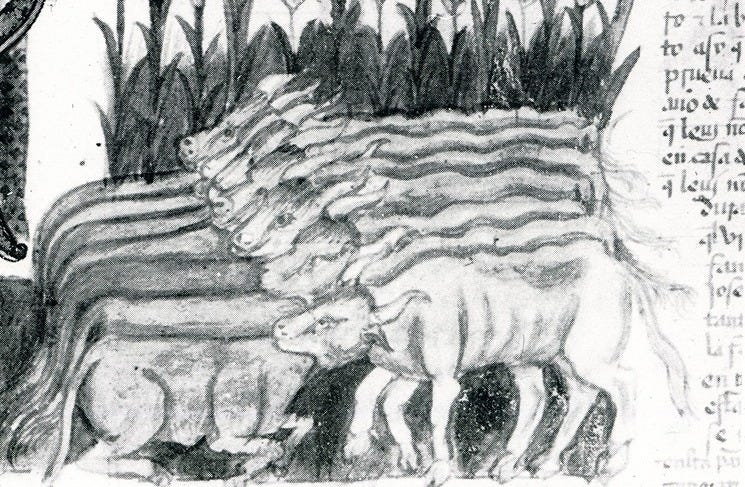
Years later (and in next week’s parsha, Mi-ketz), Pharaoh is plagued by strange recurring dreams. No man in his court can interpret or alleviate them. The cupbearer, who has since been restored to his position, remembers Joseph, and mentions him to Pharaoh. For a third time, Joseph’s gift is put to use, but for the first time, it is actively sought. Pharaoh summons Joseph with great urgency. Even as Joseph’s gift is assigned great value, echoing the favoritism he enjoyed in his youth, he does not revert back to the tactlessness of his adolescence. “Not I!” Joseph clarifies, “God will see to Pharaoh’s welfare.”
Joseph makes legible the symbolism of Pharaoh’s dreams: they prophesy seven years of abundance in Egypt, followed by seven years of famine that threaten the empire. Again, the stakes are raised—this time, an entire nation depends on Joseph’s gift. And again, the definition of Joseph’s foresight is expanded—this time, to include the ability to anticipate economic events on a national scale. Joseph lays out detailed plans for famine preparation through systematic rationing. When the famine arrives, Egypt is prepared. Not only are the people well-fed, but the surrounding nations, also affected by the famine but unprepared, become dependent upon Egypt.
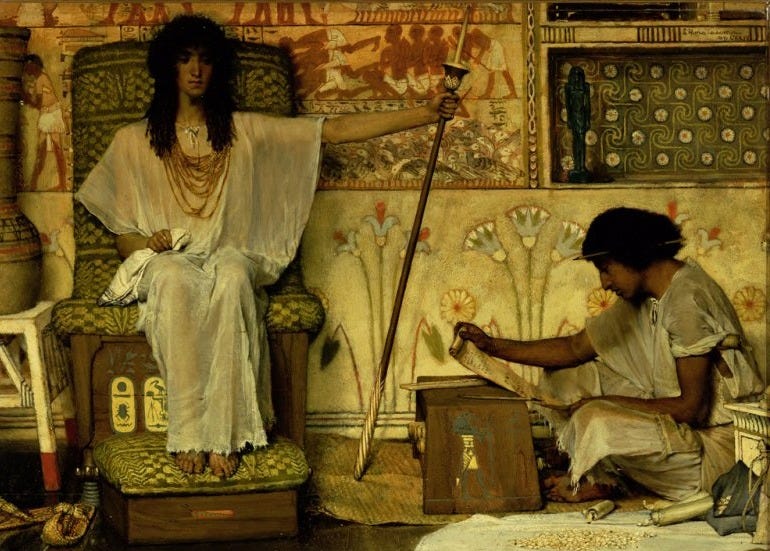
The catalyst for Joseph’s maturation is his being sold into slavery. Subordination, abuse, and, most crucially, outsiderdom, have opened Joseph’s eyes to the emotional, social, political, and economic world around him. He comes out of those experiences a survivor, with adaptive skills that allow him to make his way through different spheres of life. Instead of lording his innate gifts over his brothers, he transforms his new and greatest gift—his insider-outsider perspective, his double-consciousness—into a means to uplift the people and nation that surround him.
Genesis ends after Joseph moves his brothers and their families to settle in Egypt. Exodus opens generations later. Jacob’s sons are long dead, and a new Pharaoh, who does not know of Joseph, rules the land. TheJews have expanded from a set of families into an entire population.
The Israelites were fertile and prolific; they multiplied and increased very greatly, so that the land was filled with them. Exodus 1:7
The new Pharaoh has grown suspicious and contemptuous of the Jews in his midst, declaring to the Egyptians:
Look, the Israelite people are much too numerous for us. Let us deal shrewdly with them, so that they may not increase; otherwise in the event of war they may join our enemies in fighting against us and rise from the ground. Exodus 1:9-1:10
The Jews are enslaved.
There is a parallel between the story of Joseph and the story of the Jews. Like the young Joseph, the Jews in Egypt are growing up with many blessings. They are “fertile” and “prolific.” They spill over with giftedness. Egypt is “filled with them,” which suggests not only that they are many and growing but also that they are active, bustling in the spheres of culture and politics and the economy. Pharaoh even fears that they may “rise from the ground,” which doubles as an idiomatic equivalent to “gain ascendency over” or a literal equivalent to “leave the land.” Both equivalents suggest a potential for great power and Egypt’s dependence on them.
Like Joseph’s brothers, the Egyptians now resent the Jews. They envy their success and fear being supplanted by them. The Jews, like the young Joseph, lack any awareness of the murderous forces gathering around them, which will be activated by the new regime. They are in their own kind of adolescence.
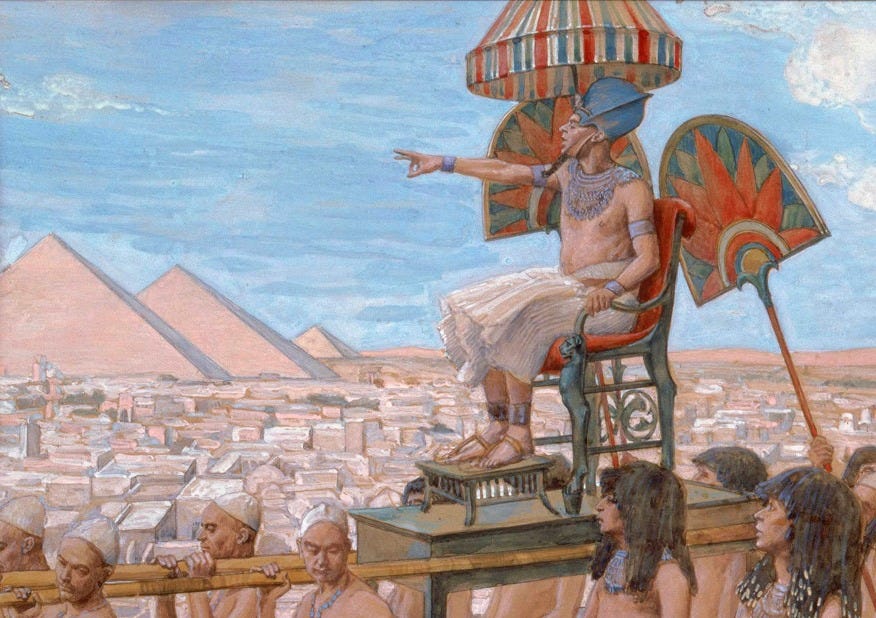
While the enslavement of the Jews is an obvious tragedy, it is also, like the enslavement of Joseph, a period of maturation. Being subordinate, thrown into the role of outsiders, they gain, collectively, the kind of double consciousness that Joseph gained when he was first enslaved, and all the skills that come with that consciousness. They slowly leave behind the world of Genesis, the era of patriarchal, dynastic Jewishness and prepare themselves for a new kind of peoplehood, which Moses will articulate.
As we read the coming weeks’ parashot, we will want to keep in mind two questions: How does slavery help the Jews develop, corresponding to the period of Joseph’s enslavement, and how does their exodus correspond to and differ from Joseph’s emancipation, and lead us out of Genesis and into the worlds of wandering, freedom, and peoplehood?
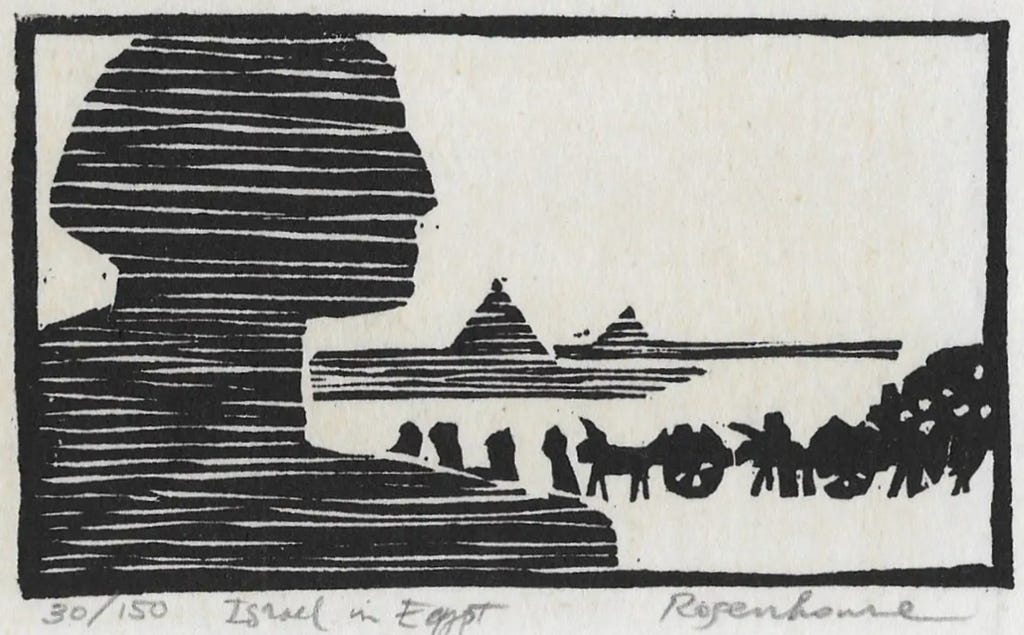
Image: “Israel in Egypt,” woodcut by Erwin Rosenhouse, 1966.