
Mishpatim
To know the feelings of the stranger

This week’s parsha, Mishpatim, continues with God’s delivery of commandments to the Jews at Mount Sinai. Among these commandments, three are distinct.
You shall not wrong or oppress a stranger, for you were strangers in the land of Egypt.
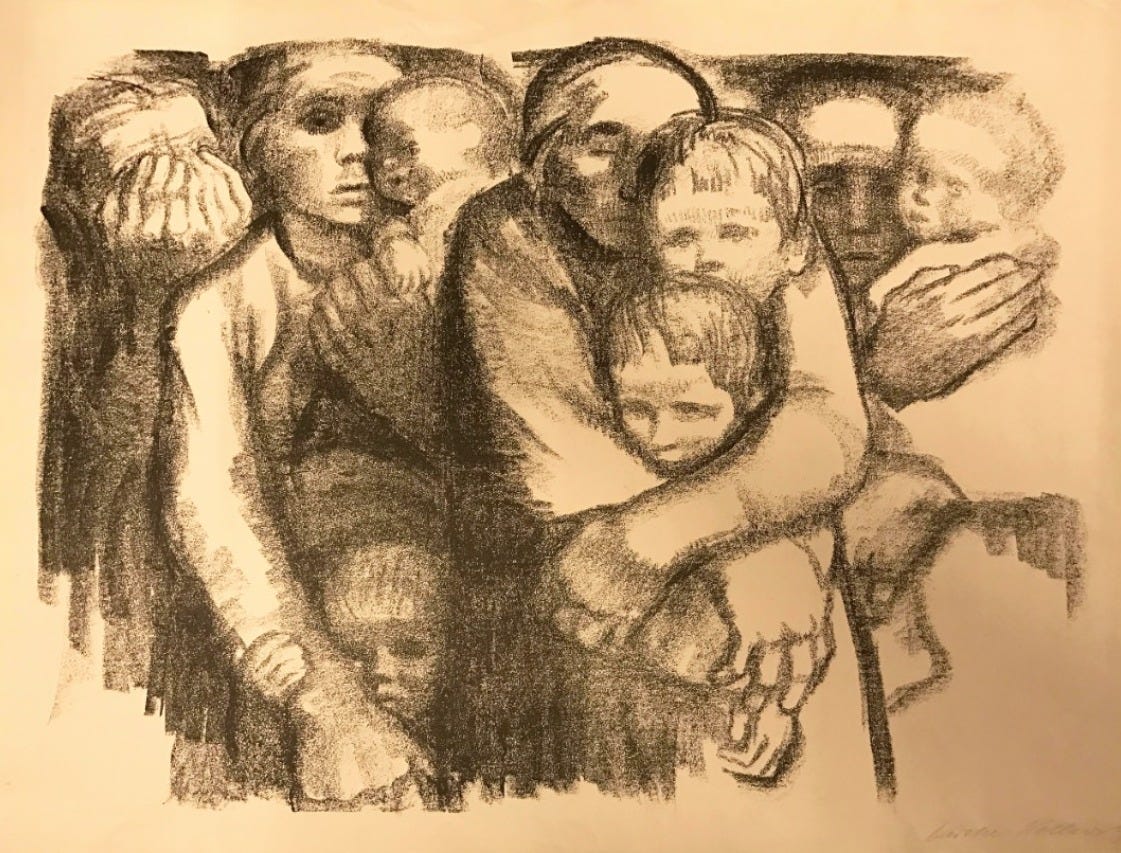
You shall not ill-treat any widow or orphan. If you do mistreat them, I will heed their outcry as soon as they cry out to Me, and My anger shall blaze forth and I will put you to the sword, and your own wives shall become widows and your children orphans. Exodus 22:20-22:23
You shall not oppress a stranger, for you know the feelings of the stranger, having yourselves been strangers in the land of Egypt. Exodus 23:9
While the other commandments entail a simple absolute statement that “you shall not” or invoke consequences if you violate the commandment, the reasoning for these commands is uniquely focused on a shared experience between the victim and the perpetrator, either a past experience or a future experience. You shall not wrong the stranger because you know what it is like to have been a stranger, and you shall not wrong a widow or an orphan because your family will know what it is like to be widowed and orphaned. Both formulations require the recipient of the command to step out of their own experience and into the experience of society’s most vulnerable.
The invocation of personal experience, especially that of slavery in Egypt, seems almost counterintuitive for two reasons. First, at the time, slavery in Egypt would have been a recent memory. We often hear that it is impossible to shake and forget trauma. So why would God feel a reminder necessary? Second, like other commands that begin with “you shall not,” the command not to mistreat the vulnerable seems not to require a “because.” It is an intrinsically good act. Why would we need a shared experience with a victim in order not to victimize them?
These questions make sense, but rest on one interpretation of the text. A second, different interpretation gives some answers. In the first interpretation, God always needs to provide a reason or motivation for the Jews’ obedience, whether it be God’s authority (thou shalt not), the possible consequences of bad actions (you’ll be punished), or a personal obligation based on experience.
In the second interpretation, what God is commanding is less the action of the command—not wronging or oppressing the stranger, not ill-treating the widow or the orphan—than the mindset, the way of thinking and feeling, that should accompany the action. God is working on the assumption that the Jews will not oppress or wrong the stranger, the widow, or the orphan. What God is interested in is the ethos that should go with the Jews’ righteous treatment of society’s most vulnerable groups.
By directing the thoughts of the Jews, God pushes them to be intentional, to take them out of themselves, and to remember events or imagine possible events. This mindfulness takes the Jew out of the present and throws them into the past or the future, which is what the Exodus story is about. So much of the conflict between Moses and the Jews in Egypt and out of Egypt is sparked by the Jews’ inability to imagine themselves in a narrative. Blinded by trauma, they cannot see the present as different from the past, and they cannot fathom a future for themselves other than suffering and slavery. Past, present, and future all merge into one moment from which the Jews cannot disentangle themselves. The Jews struggle to imagine being a different version of themselves, let alone being someone else. These commands, which push the Jews to do just that, serve the double purpose of uplifting strangers, widows, and orphans and uplifting the Jews themselves. The ability to imagine yourself as different from what or who you currently are is clearly something God sees as especially holy. Through these commandments, God embeds this abstract imagination in action.
Image: Käthe Kollwitz’s “Widows and Orphans,” 1919.