
Tol'dot
Nobody's son, nobody's father

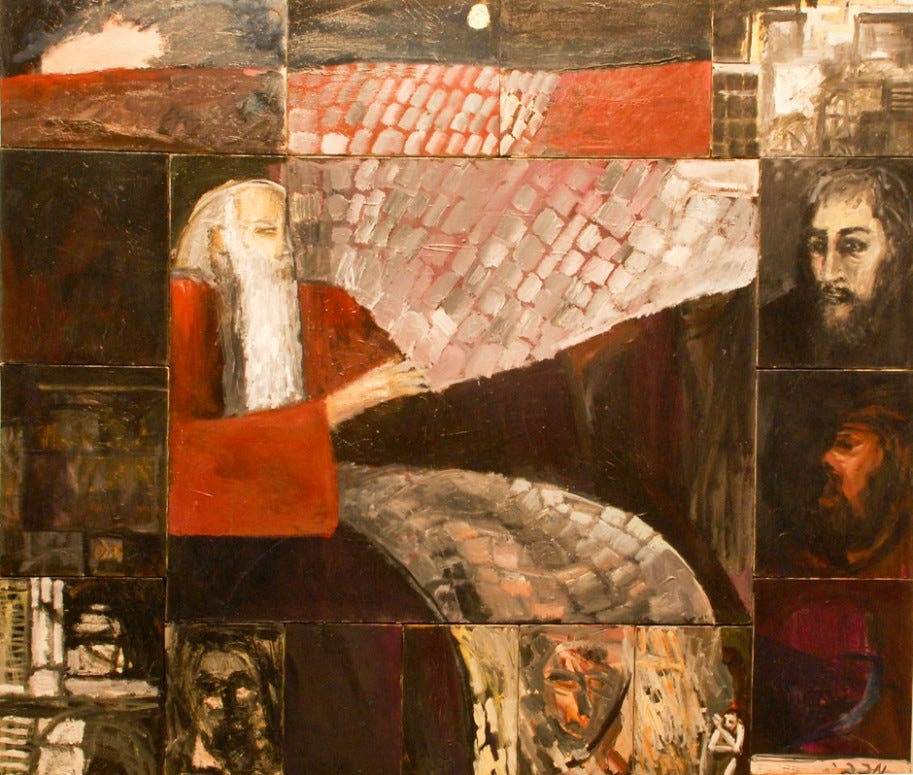
While I am frequently moved, sometimes to tears, by the weekly parsha, my reaction to Tol’dot this week was particularly strong. The story of Jacob, Isaac, and Esau is unlike any story in the Torah. There is tragedy aplenty in the Torah, much of it involving inter-generational trauma. The father-son relationship between Isaac and Esau, the subject of this week’s essay, can seem like just another link in a chain that did not begin or end with them. But there is something in their relationship that is uniquely tragic.
We saw last week that Rebekah filled a void in Isaac created by the death of his mother Sarah. If Rebekah fills the void left by Sarah, Esau, Isaac’s first son, fills the void left by Abraham. It’s not surprising, then, that, in Tol’dot, Esau finds himself in a hopelessly torturous relationship with his father.
People often read this parsha as a simple story of brotherly rivalry: Isaac loves and favors Esau in the same way that Rebekah loves and favors Jacob. Each parent loves a different son. The text reads differently. It suggests that while Rebekah favors Jacob simply because she loves him, Isaac loves Esau because of his huntsmanship and love of game. Isaac’s love of Esau is conditional, dependent upon something other than the tie of blood.
Isaac’s preference for Esau is also notable because the father and son could not be more different. Esau—wild, powerful, athletic, defined by his huntsmanship, his ability to kill—is everything Isaac is not. Isaac admires Esau. Isaac calls Esau to hunt and cook meat for him because he cannot hunt himself. If anything, Isaac has always been the hunted, the victim of his father’s willingness to sacrifice him to God, an experience Isaac never recovers from. More than finding comfort in his son’s success, Isaac gets to imagine himself as a hunter through his son. Esau and Isaac reverse, or rather, confuse, the parent-child roles. Isaac molds Esau into the father that Abraham never was and the man he never became. The Akedah robbed Isaac of a father and a self, and now Esau must bear the load of providing both.
The central event of Tol’dot is when Jacob and Rebekah conspire to trick Isaac, who is now old and blind, into giving Jacob, not Esau, his blessing. It’s a necessary deception for the advancement of the Godly project: God decides that Jacob is the next patriarch, Isaac favors the wrong son, so he must be deceived. Despite the justification for this deception, the text does not pull any punches in depicting its consequences.
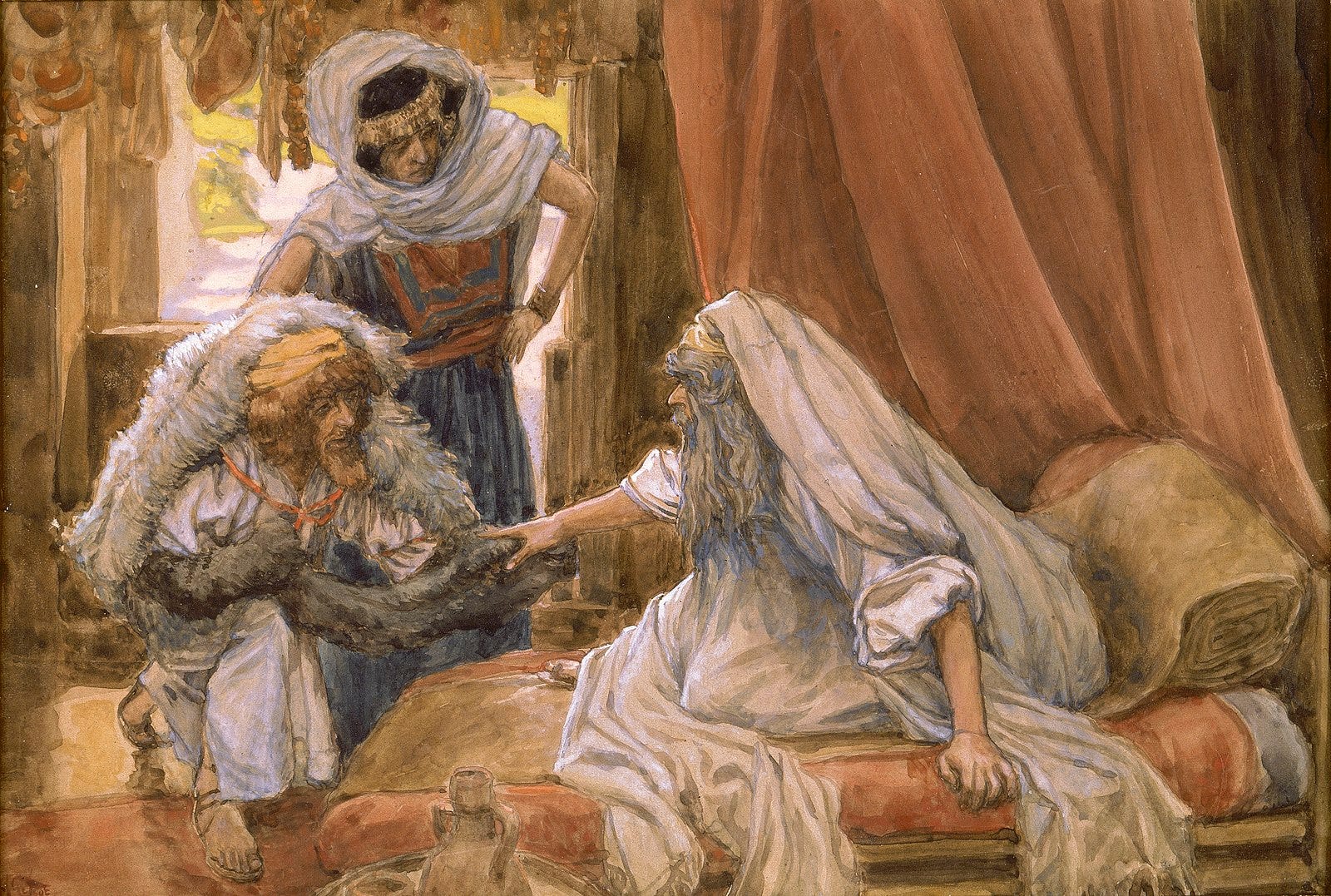
Despite Isaac’s inability to see his son, Jacob cannot fully mask his voice. Isaac seems to sense that something is wrong. But instead of voicing any doubts aloud, he asks questions, prodding at the inconsistencies of Jacob’s elaborate lie. Isaac had told Jacob, whom he thinks is Esau, to hunt, kill, and prepare an animal for him as a meal. With his mother’s help, Jacob returns quickly. Too quickly. When Isaac asks Jacob to explain his speed, Jacob replies, “Because your God יהוה granted me good fortune” (Genesis 27:20). Jacob’s answer mirrors the only words Abraham expressed to Isaac during the Akedah:
Then Isaac said to his father Abraham, “Father!” And he answered, “Yes, my son.” And he said, “Here are the firestone and the wood; but where is the sheep for the burnt offering?” And Abraham said, “It is God who will see to the sheep for this burnt offering, my son.” Genesis 22:7-22:8
Isaac seems to know the horrible truth about Jacob’s deception, but cannot confront it. He blesses Jacob instead. Soon after, Esau returns, eager to receive his blessing, and the truth becomes unavoidable. Esau has but to speak aloud for Isaac to acknowledge what has transpired. No other confirmation is necessary.
The language describing Isaac’s reaction is jarring. He is “seized with very violent trembling,” an image that evokes a deep, elemental terror. Multiple truths have been revealed. First, once again, he has been betrayed by a family member. Second, once again, he has been sacrificed for the purpose of advancing God’s will. Third, he has failed as a patriarch. He realizes that Esau was never the son to succeed him, that he chose incorrectly, out of line with God’s plan. Last, and most crucial, his view of Esau is shattered. Esau is no longer the strong hunter, impervious to harm. He has been slighted, he has been victimized. Esau has become Isaac. Without Esau, Isaac becomes Isaac again.
At this moment, Isaac needs Esau more than ever. What does Esau need? He erupts into sobs, crying, “Bless me too, Father!” Isaac responds by deflecting any agency from himself, blaming everything on Jacob: “Your brother came with guile and took away your blessing.” Even in Isaac’s account of the story, he is a non-character, absent from the narrative entirely. As Esau begs Isaac to take action, Isaac can only bounce the agency back onto Esau, asking, “What, then, can I still do for you, my son?” (Genesis 27:34-27:37).
While it might seem impossible for Isaac to undo what he has done, his helplessness is frustrating. After all, the most successful Biblical figures were those who transgressed, and in doing so, achieved the impossible. Abraham dared to argue with God, challenging God’s decision to destroy Sodom and Gomorrah and eventually bartering his way to a compromise. Contrary to Isaac’s acceptance of his and Esau’s victimization, there is a precedent for fighting back. But to Isaac, who has learned helplessness all his life, there is no will to fight.
This is the first moment in the Torah when family tragedy is not just unrequited love, sacrifice, or resentment turned homicidal. Esau and Isaac are truly and utterly stuck within themselves. In the moment they need each other most, neither can help the other. Esau begs his father, for once, take action, be a father, be my father. Isaac, still and forever bound on the altar, begs Esau, begs Abraham, help me, I’m stuck, I cannot move, take action, be a father, be my father. Each wants something the other cannot give. They cannot comfort each other. They both have been so victimized that they don’t have the resources to see each other or make a connection. Who hasn’t been both Isaac and Esau, in a friendship, a relationship, a family?
As characters, Esau, but especially Isaac, feel unusually out of step with the time. The Greek tragic hero advances his fate by fighting against it, and achieves a sort of honor through it. The Jewish hero uses wit and foresight to wrestle with God and tradition, and is honored for his transgressions. Isaac fits neither with his fate-fighting contemporaries nor the fate-condemned heroes of Greek tragedy. Isaac is modern, a man without qualities. He is the Sabrina Carpenter character with none of the self-satire.1

Image: “Stolen Blessing” by Richard McBee
Like the bridge in “Manchild,” when Sabrina, after a whole song of complaining about the unsavory men she keeps dating, sings “Oh, I like my boys playing hard to get/And I like my men all incompetent/And I swear they choose me, I’m not choosing them.”