
B'midbar
Spinoza's Moses

B’midbar, or Numbers, the fourth of the five Books of Moses, opens with a census and a military draft. In previous books, Moses established the Jewish law and the Jewish priesthood. Now, he and God turn to creating a military that will take the promised land, Canaan. While Moses takes on this additional role of military strategist—he’s already established himself as prophet and judge—Aaron’s power continues to be diminished, and the brothers’ relationship all but deteriorates. At the same time, Moses, burdened with the task of preparing Jewish society for life after his death, struggles to preserve the law and authority he has built without a single successor.
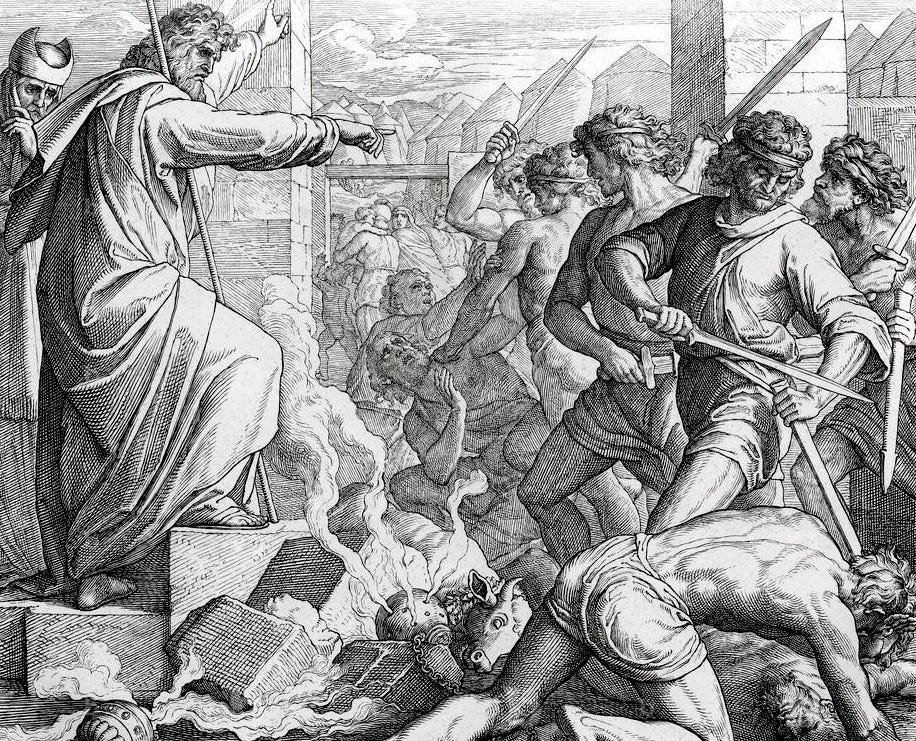
In B’midbar, we also see the reappearance of the Levites. The only one of the twelve tribes of Israel that did not commit idolatry at Sinai with the golden calf, the Levites were called upon by Moses to avenge God and slaughter the idolatrous Jews. In B’midbar, the Levites are again called upon for a peculiar purpose. God instructs Moses:
Advance the tribe of Levi and place them in attendance upon Aaron the priest to serve him. They shall perform duties for him and for the whole community before the Tent of Meeting, doing the work of the Tabernacle… You shall make Aaron and his sons responsible for observing their priestly duties; and any outsider who encroaches shall be put to death…I hereby take the Levites from among the Israelites in place of all the male first-born, the first issue of the womb among the Israelites: the Levites shall be Mine. Numbers 3:5–3:12
The Levites are promised no land in Canaan. Rather, they are to become wandering cultic functionaries, given quasi-priestly authority and policing power. The Levites’ new role as armed assistants to Aaron is puzzling. Given his role in the golden calf debacle, Aaron should be the Levites’ greatest enemy and foremost target. Yet their insertion into priestly duties is framed as a boon to Aaron. In reality, by giving the Levites power in both the legal and priestly realms, God and Moses are diminishing Aaron’s power: they are making his office less exclusive, no longer limited to his direct lineage.
This is just the latest of Moses’s efforts to systematically disarm Aaron following the golden calf episode. At each step, Aaron’s power as a leader is subtly diminished, sometimes under the pretense of formalizing and expanding it. This process might best be understood through Max Weber’s concept of the routinization of charismatic authority, the posthumous transformation of a leader’s unstable, revolutionary charisma into a stable, non-threatening, state-sanctioned institution. Although Aaron’s power is routinized during his life, the process is the same. As his authority is streamlined into the state-sanctioned institution of the priesthood and status as High Priest, Aaron is, in actuality, losing his influence over the public.
First, Aaron is selected as High Priest. Initially, this came as a surprise—why would God and Moses assign Aaron a culturally influential, powerful position after his involvement in the golden calf episode? However, as the role and duties of the priesthood are set out in Leviticus, we see how the office in fact curbs Aaron’s influence. The priesthood’s duties are defined by ritual and routine. Every aspect of priestly duty is detailed and defined with strict precision. Leviticus serves as a handbook to be consulted, leaving no room for the priests to govern by their own judgment. It is perhaps by design that Bnei Mitzvah dread receiving parashot from Leviticus because there is so little room for interpretation.
Second, in Parsha Sh’mini, Aaron’s two eldest sons, the immediate heirs of the High Priest title, are killed by God under mysterious circumstances. In my essay on the parsha, I discussed Moses’ bizarre response to the tragedy:
And Moses said to Aaron and to his sons Eleazar and Ithamar, “Do not bare your heads and do not rend your clothes, lest you die and anger strike the whole community. But your kin, all the house of Israel, shall bewail the burning that GOD has wrought. Leviticus 10:6
Moses, the product of a leader-making formula God perfected with Abraham, Isaac, and Jacob in Genesis, is an exemplar of detachment from family for the sake of God and the Jewish people. He is able to compartmentalize his personal life and emotions, and now he educates the Kohanim—Aaron and his two remaining sons—in how to do the same. Perhaps this whole ordeal has been an initiation ritual for the priestly line, harkening back to Abraham’s departure from Ur or Jacob’s severance from Esau. The difference here is that Aaron is a fully grown man, while the formative experiences in Genesis usually occur at the beginning of the great leaders’ stories. Maybe the lesson in detachment is directed not at Aaron but his sons, Eleazar and Ithamar, who are younger and thus can provide a more malleable future to the priestly line. Once the future has been secured, Aaron seems like more of a liability.
While Aaron is still reeling from witnessing the deaths of his eldest sons, Moses swoops in to instill his own philosophy of leadership among Aaron’s two remaining sons. At this point, Moses has curbed Aaron’s influence over the general public, and now, Aaron’s family.
Finally, with the introduction of the Levites as legal enforcement, religious authorities, and Aaron’s “guardians” in B’midbar, Moses and God create a flexible class that secures the priesthood against threats to the Jewish project, both external and internal, including from Aaron.
Ruthless as he may be, Moses is not just setting up institutions to ensure social stability during and after Aaron’s life; he is also preparing for Jewish life after his own death—routinizing his charismatic authority, or attempting to. Moses himself has no direct successor, only the institutions he leaves behind and the Torah itself.
Recently, I’ve been interested in the readings of Moses—by Maimonides, Machiavelli, Spinoza, and Strauss—as a uniquely political, nearly secular, leader. Machiavelli modeled Moses as a leader in the vein of Cyrus, Theseus, and Romulus, all of whom he viewed as self-made strategists who enforced their rules with armed forces. Maimonides modeled Moses as a prophet guided by pure, rational intellect, in contrast to the other prophets whose prophecies were mediated by imagination. Strauss read Maimonides’s Moses as an enlightened philosopher-king who set out laws and religious institutions for the masses to maintain social order and control. Similarly, Spinoza approved of Moses as a prophet-politician, suggesting that his purposeful combination of law and religion created a more cohesive Jewish populace.
Maimonides argued that Moses, as the singular prophet of rational intellect and the sole Jewish legislator, could not have a true spiritual successor, only “admonishers” who followed in and preserved his tradition (Guide 302). Maimonides saw danger in the possibility of a prophet who threatened the authority of Moses’ teachings, and cited the importance of Moses’ singularity so that “should a prophet arise who performs great signs and wonders but seeks to discredit the prophecy of our Teacher Moses, we do not heed him…For Moses’ prophetic inspiration did not depend on signs that might be compared, these against those” (Mishneh Torah Laws of the Foundations of the Torah 8). Instead of selecting one successor and making Jewish society a monarchy, Spinoza argued, Moses left the foundations of a theocracy.1
In constructing a network of offices and institutions, Moses aims to protect the Jewish people and society—against Aaron or figures like Aaron, against themselves—following his death. In the process, he isolates himself from his people and not only destroys his relationship with his brother, but also isolates Aaron from the community, too.
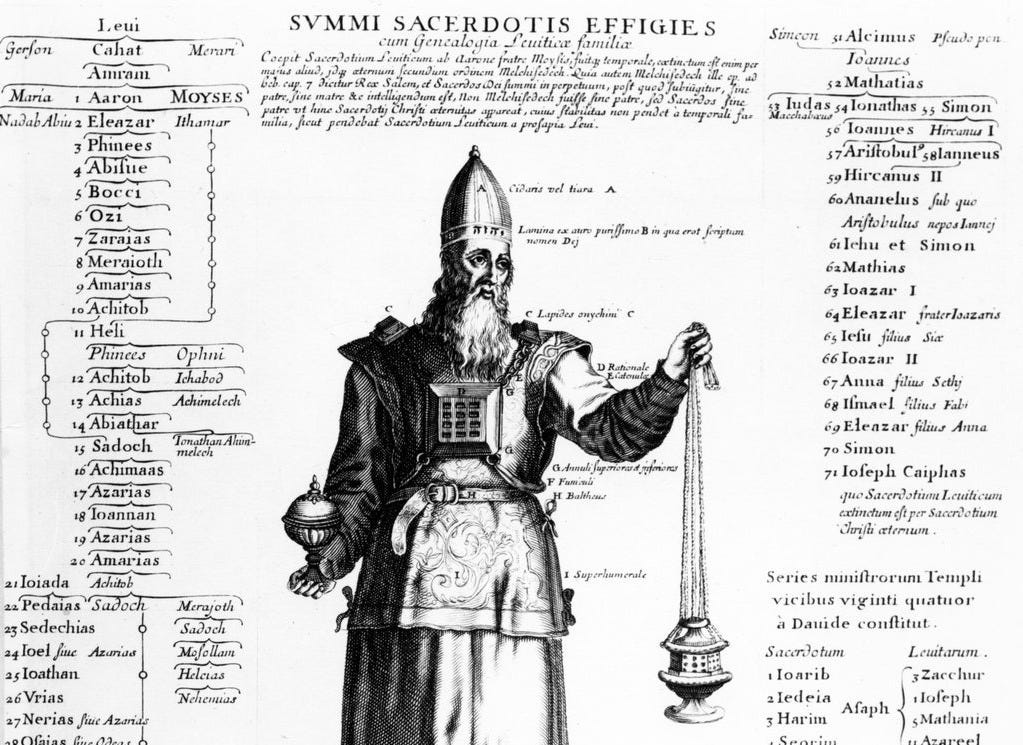
Image: “The High Priest of Judaism, and the genealogy of the priestly family of Levi,” engraving from the French School, undated. https://www.meisterdrucke.us/
Spinoza fixated on the Levites as a fatal flaw in Moses’ theocracy. Initially, Spinoza argued, God and Moses intended that the legal and priestly duties be delegated to the firstborn of all the tribes, not just the Levites. After the golden calf, the Levites alone were selected instead of the now-rejected firstborn, hence “I hereby take the Levites from among the Israelites in place of all the male first-born” (Numbers 3:12). “God’s object at that time was not the safety of the Jews, but vengeance,” Spinoza wrote, “I am greatly astonished that the celestial mind was so inflamed with anger that it ordained laws…with the purpose of vengeance, for the sake of punishment; so that laws do not seem so much laws—that is, the safeguard of the people—as pains and penalties” (TPT 233). From then on, Spinoza reasoned, what might have brought the tribes together in shared religious duty and legal interpretation became one tribe’s elitism and a source of fission in the commonwealth.