
Sh'mini
Aaron and Auerbach

Two weeks ago, with the opening of the book of Leviticus, I wrote about how Leviticus is often seen as a boring set of incomprehensible and tedious instructions, in contrast with the horror and drama of the more narrative books, Genesis and Exodus. After reading this week’s parsha, Sh’mini, it’s become clear that that could not be further from the truth; Leviticus is a human drama as much as the Torah that precedes it. Amid all the details and instructions for ritual and routine, the text keeps tugging at the past, calling back to the costs of what it takes to get to ritual, routine, and boredom.

Last week, in Parsha Tzav, we got some hint and hope of a private reconciliation between Moses and Aaron after their falling out over the golden calf. In Sh’mini, Moses calls Aaron to perform a purifying ritual for him, his family, and the Jewish people. Everything goes smoothly, and at the end, Aaron and Moses go, together, into the Tent of Meeting, the private place where Moses confers with God. After sharing a moment, the brothers return and perform blessings together, as one. God, pleased, accepts the ritual sacrifice. For a moment, it seems as though joint leadership—a return to the “good old days” of Egypt and the exodus—is once again possible.
As quickly as the moment begins, it is over. The focus shifts to Aaron’s two eldest sons, Nadab and Abihu, the heirs to the priestly title:
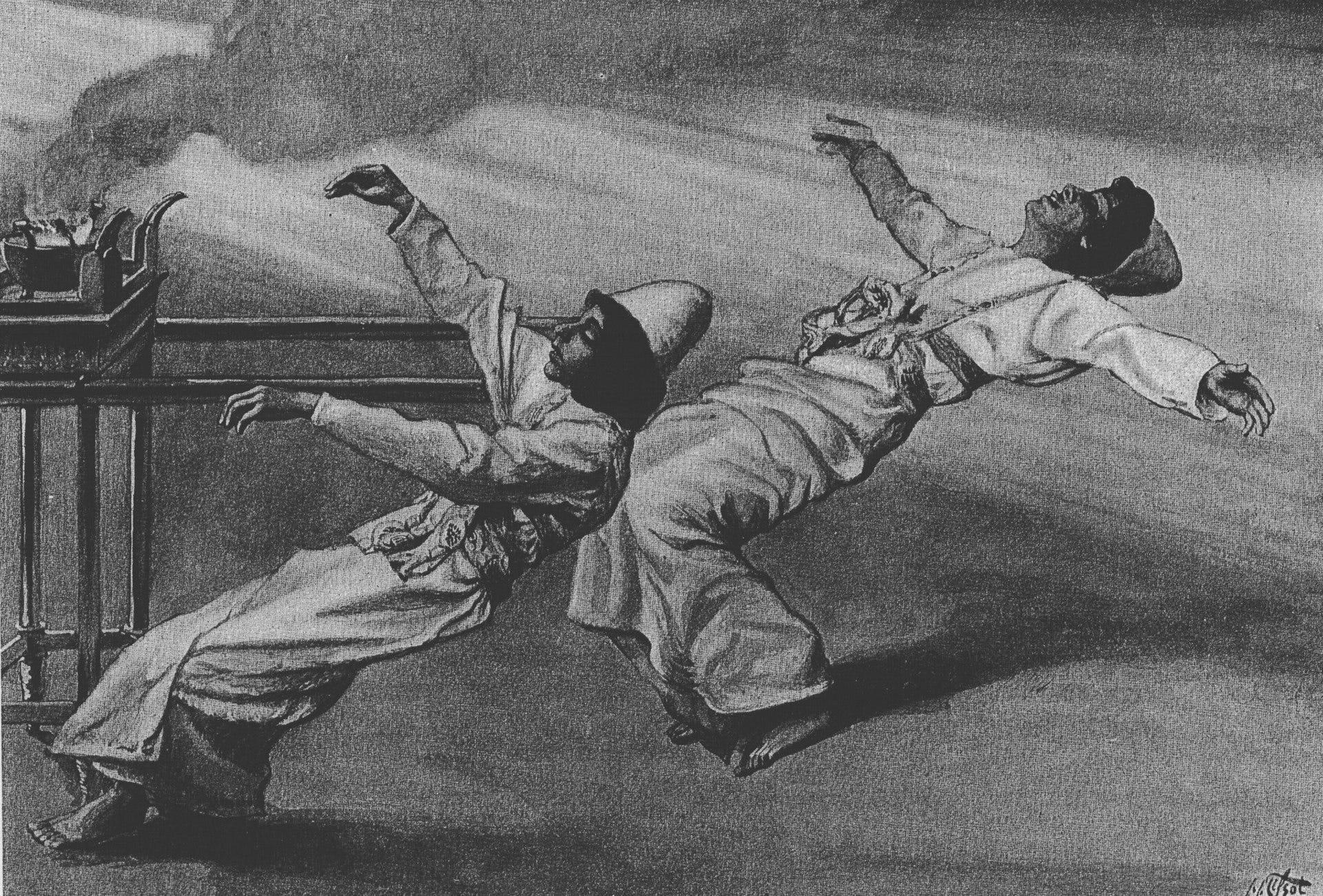
Now Aaron’s sons Nadab and Abihu each took his fire pan, put fire in it, and laid incense on it; and they offered before GOD alien fire—which had not been enjoined upon them. And fire came forth from GOD and consumed them; thus they died by GOD’s will. Leviticus 10:1–10:2
The sequence of events is terrifying, rapid-fire, and vague. For some reason, debated among sages and scholars, Nadab and Abihu screw up the ritual. Maybe it is the mysterious incense, maybe it is the sudden fire in the Tabernacle, maybe it is the fact that each brother took his own pan (arrogance), maybe it is the fact that they lit the fire without allowing God to do it (presumptuousness), or maybe it was their acting when uninstructed (over-eagerness). Whatever the essence of their transgression, God incinerates the brothers in front of their father and uncle.
What was already a shocking and sudden turn is made more disturbing by Moses’ immediate reaction:
Then Moses said to Aaron, “This is what GOD meant by saying:
Through those near to Me I show Myself holy,
And gain glory before all the people.”
And Aaron was silent.
Leviticus 10:3
Aaron has just witnessed his sons burned alive, and Moses’ response is to moralize. We might expect Moses to comfort Aaron, or express his grief at the deaths of his nephews. Instead, his impersonal reaction seems totally inappropriate to the gravity of what has transpired. Most chilling, however, is “and Aaron was silent.” The Torah is sparse with its details, especially in dialogue. Speech in the Torah, in the words of Eric Auerbach, “does not serve, as does speech in Homer, to manifest, to externalize thoughts—on the contrary, it serves to indicate thoughts which remain unexpressed.” Aaron’s silence—its own kind of speech—and the fact of its inclusion at all, are fraught with possibility for what is left unexpressed.
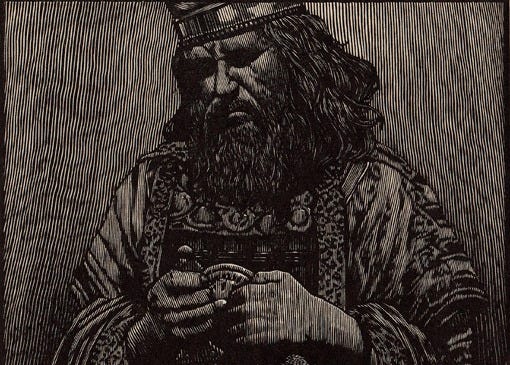
And what of Moses’ apparent apathy? I had spent all of Parsha Tzav toying with the possibility of a between-the-lines reconciliation between the brothers, but the Moses of Sh’mini seems to be telling me that there is, in fact, no reconciliation or warmth underneath Moses’ chilling pragmatism as a leader and absolute fidelity to the Jewish project. After the bodies of Nadab and Abihu are taken away, Moses advises the priests to conceal their grief from the public:
And Moses said to Aaron and to his sons Eleazar and Ithamar, “Do not bare your heads and do not rend your clothes, lest you die and anger strike the whole community. But your kin, all the house of Israel, shall bewail the burning that GOD has wrought. Leviticus 10:6
Moses, the product of a leader-making formula God perfected with Abraham, Isaac, and Jacob in Genesis, is an exemplar of detachment from family for the sake of God and the Jewish people. He is able to compartmentalize his personal life and emotions, and now he educates the Kohanim—Aaron and his two remaining sons—in how to do the same. Perhaps this whole ordeal has been an initiation ritual for the priestly line, harkening back to Abraham’s departure from Ur or Jacob’s severance from Esau. The difference here is that Aaron is a fully grown man, while the formative experiences in Genesis usually occur at the beginning of the great leaders’ stories.
Maybe the lesson in detachment is directed not at Aaron but his sons, Eleazar and Ithamar, who are younger and thus can provide a more malleable future to the priestly line. Once the future has been secured, Aaron seems like more of a liability, too stuck in his past as a family man or a man like the men of Genesis. To this point, God instructs Aaron:
Drink no wine or other intoxicant, you or your sons, when you enter the Tent of Meeting, that you may not die…for you must distinguish between the sacred and the profane, and between the impure and the pure. Leviticus 10:9–10:10
While some sages interpret this as an indictment of Nadab and Abihu, implying that their sin had been mishandling the ritual in a drunken stupor, my mind turned immediately to Noah. Noah’s downfall, being seen naked by his son, was catalyzed by his drinking immediately after exiting the ark. Noah’s motivations, too, were unspecified, but it’s easy to interpret his drunkenness as a response to the mass death during the flood or a kind of survivor’s guilt. Although spoken like another commandment in Leviticus, God’s timely instruction to the priests not to drink mirrors Moses’ advice for the Kohanim to conceal their grief; though with Aaron it reads more like damage control. His grief, and how he might cope with it, poses a risk to the stability of Moses and the priests’ leadership. God and Moses must step in and forbid Aaron coping through drink or any means that might make his grief known to the public.
I wrote last week about how Aaron, in Leviticus, has undergone a role reversal from his younger, Exodus self. Such character transformations, arcs that seem to unfold in the background of the text, are standard in the Torah. To this point, Auerbach writes:
…What a road, what a fate, lie between the Jacob who cheated his father out of his blessing and the old man whose favorite son has been torn to pieces by a wild beast!—between David the harp player, persecuted by his lord’s jealousy, and the old king, surrounded by violent intrigues…it is this history of a personality which the Old Testament presents to us as the formation undergone by those whom God has chosen to be examples. Fraught with their development, sometimes even aged to the verge of dissolution, they show a distinct stamp of individuality entirely foreign to the Homeric heroes.
The transformations of Old Testament figures, though not explicitly stated, are evidenced by simply comparing where these figures start and their final moments. In Exodus, Aaron is the mouthpiece for Moses, selected by God for his confidence and speech, both of which Moses lacks. By Sh’mini, Aaron is defined by his lack of speech entirely. His “history of personality” is a journey from speech to silence. In my essays, I’ve explored the costs of the Jewish project; how it tears families apart and transforms characters. But here, in Aaron, in Aaron’s arc, we see not only a victim of these consequences but also a witness to them. Aaron’s silence leaves him to watch, recognize, and process the events unfolding in the text, and, so burdened by the costs of these events, he becomes not only a character but also a spectral companion to the reader.
Image: Tissot’s “The Two Priests are Destroyed.”
Interesting that you chose to focus on Aaron and not on Nadav and Abihu. Aaron's transformation to silence after witnessing their death, especially after being the mouthpiece of God, is powerful. Amazing how one sentence can hold so much power. Thank you for drawing it to my attention. I actually read that exact passage this Shabbat (and messed up right at the point when Aaron was silent).