
Ḥayyei Sarah
First love


Last week, we left off, in Va-yera, with Abraham’s sacrifice of his son Isaac. It is in Va-yera, when God calls on Abraham to kill Isaac, that the verb “אהב,” or “to love,” is used for the first time in the Torah. While this first instance refers to the love of a child, the next use of “אהב” appears in this week’s parsha, Ḥayyei Sarah, but in reference to the love of a spouse.
After Sarah’s death, Abraham sends out a servant to select a wife for Isaac. The father and son have not spoken since the events of Va-yera. Abraham’s servant selects Rebekah, a young woman from Abraham’s homeland, for her unique kindness and hospitality. The choice goes over well with Isaac:
Isaac then brought her into the tent of his mother Sarah, and he took Rebekah as his wife, Isaac loved her, and thus found comfort after his mother’s death. Genesis 24:67
The first two appearances of loving in the Torah involve Isaac: Abraham loves Isaac, and Isaac loves Rebekah. Both instances of love are also colored by betrayal. Abraham is ready to kill Isaac at God’s command, and later, in Tol’dot, Rebekah facilitates Jacob’s deception of Isaac, betraying her husband. Between these two moments in the Torah, Isaac becomes a patriarch stripped of agency. He stands out among the biblical line as exceptionally passive, eclipsed by his father and son, the Jewish patriarchs who precede and succeed him. What, then, is the relationship between Isaac’s unique qualities—his experience of love and loss—and his passivity?
Of the first four matriarchs and patriarchs—Abraham, Sarah, Isaac, and Rebekah—who dominates the conversation, and who shrinks into silence? Isaac defers to both his father and his wife. On a surface level, Abraham and Rebekah’s narrative similarity makes sense. After all, Rebekah was selected by Abraham. Abraham even insists that his servant select a woman from his native land, not of Canaanite origin. Rebekah is Abraham’s sister-in-law’s granddaughter, a familial connection not unusual for the Torah’s convoluted family trees, but significant in linking Rebekah and Abraham.
Abraham and Rebekah’s crucial similarity is how they function in God’s larger project of creating a chosen people, a people defined by both blood ties and righteousness. By Ḥayyei Sarah, Abraham has come to understand and embody these characteristics. In Isaac, God and Abraham see a blood relation (Isaac born to both a matriarch and a patriarch), but not the righteous quality necessary for advancing the Godly project. But God and Abraham have come too far to fail, and they must work around the problem of Isaac. This is where Rebekah comes in. In Tol’dot, Isaac favors his son Esau, a fiery hunter, over Jacob, the softer, craftier son. As we know, it is Jacob who is fated to continue the Jewish line, not Esau. Isaac, narratively speaking, chooses the wrong son. As a patriarch, tasked with advancing the Godly project through progeny, he fails. It is, in fact, Rebekah—who helps Jacob deceive his blind father, tricking Isaac into blessing Jacob and not Esau—who fulfills the patriarchal duty. In Rebekah’s action and Isaac’s inaction, Rebekah proves to be Abraham’s true heir.
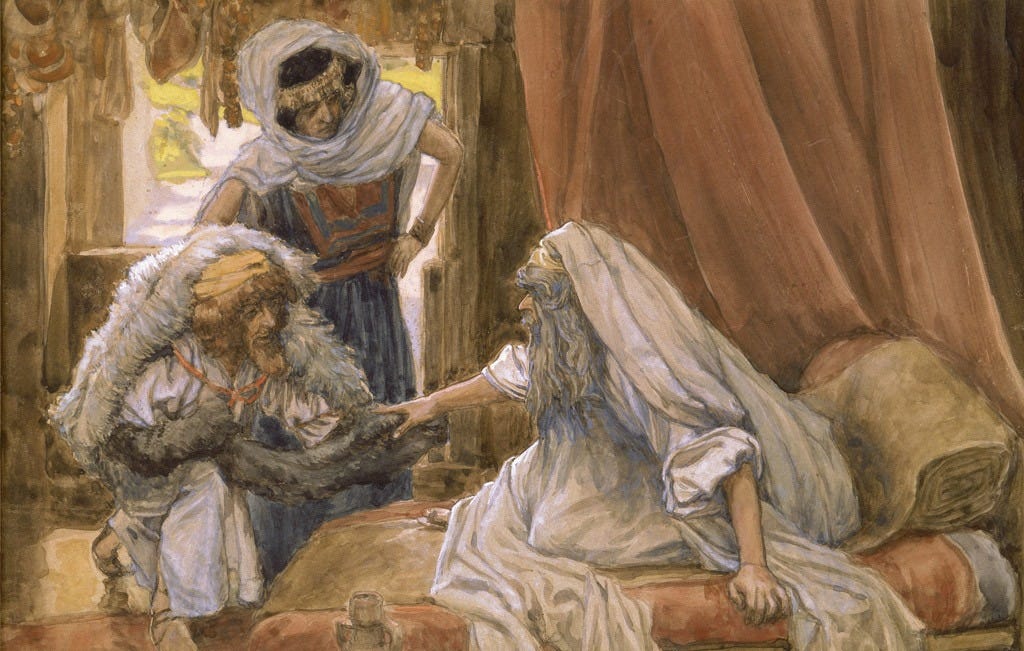
When considering the women who preceded Rebekah, her influence becomes more apparent. Both Eve and Lot’s wife defy commandments and expectations. Eve eats the apple, Lot’s wife turns around. But these women’s transgressions, unlike the transgressions of a figure like Abraham, who repeatedly puts those closest to him in danger, lead to destruction and their demise. Rebekah’s transgressions, betraying her husband and her eldest son, like Abraham’s, serve to build a powerful nation and people.
Returning to the use of “אהב” in Ḥayyei Sarah, it reads with a tragic irony. Sarah’s death, the first event of the parsha, comes directly after Abraham’s near-sacrifice of their son. Perhaps, many commentators have suggested, Sarah died of heartbreak and shock upon hearing what happened. Isaac, grieving the loss of Sarah and avoiding the shadow of Abraham, “finds comfort” in a spouse, substituting one love with another. Although Rebekah’s presence reminds him of his mother, she is, as he is about to find out, more like his father. Rebekah is not Isaac’s shield against his past but a shadow from the past that he will never escape.
Image: “Isaac and Rebecca” by Richard McBee, 1995