
Koraḥ
For all the community are holy, all of them

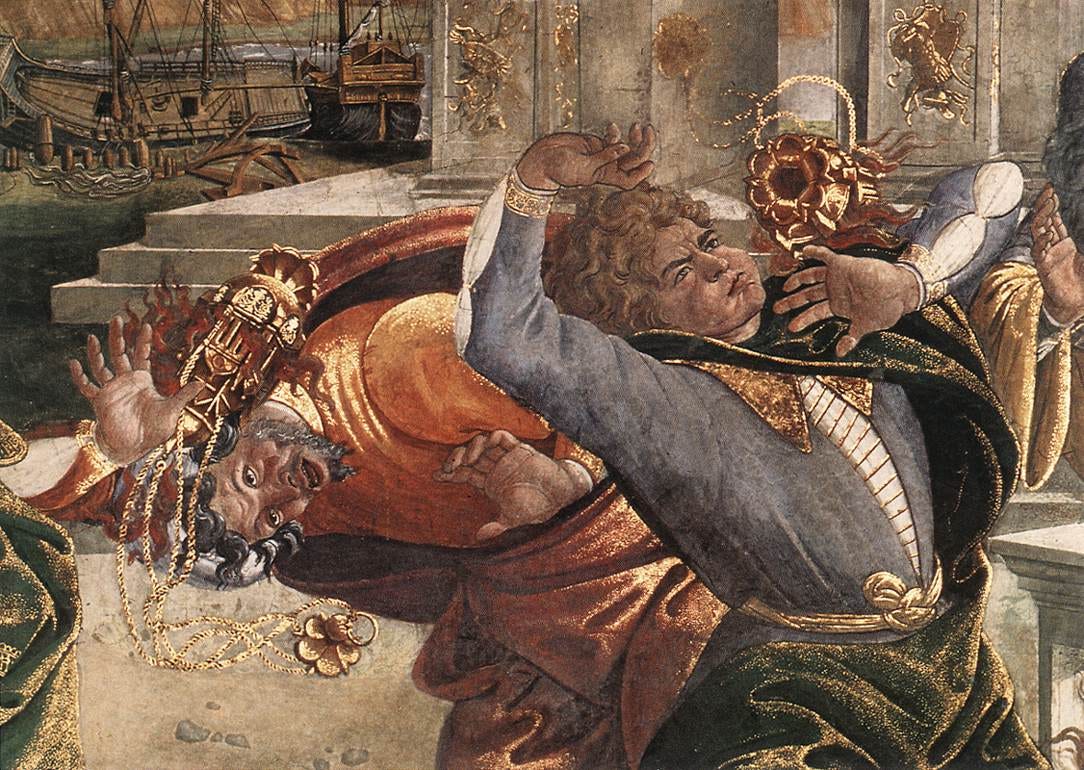
In this week’s reading, Parsha Koraḥ, Koraḥ mounts a failed rebellion against Moses, Aaron, and the priests. Koraḥ is a Levite. Enraged by the priestly privileges of Aaron and the Kohanim, he gathers 250 other Levites to stage a coup. “You have gone too far!” the angry Levites charge Moses. “For all the community are holy, all of them, and GOD is in their midst. Why then do you raise yourselves above GOD’s congregation?” (Numbers 16:3).
To modern ears, mine included, Koraḥ’s revolutionary ethos is appealing. Leviticus was practically dedicated to Moses’ efforts to create an independent priesthood, excluding everyone but Aaron’s bloodline. In Numbers, Moses took great pains to consolidate his leadership at the expense of Aaron, Miriam, the priesthood, and the community. When Koraḥ calls out the stratification in Moses’ blueprint for Jewish society, he sounds like an egalitarian truth-teller.
At the same time, Koraḥ’s status as a Levite might make him a hypocrite. The Levites occupy a strange, flexible role: They have priestly authority and legal authority, and, as of Parsha Koraḥ, they collect tithes from the public. Spinoza saw great danger in the Levites, whom he saw as unfairly and unwisely elected by God and Moses out of vengeance over the community’s embrace of the golden calf. As I wrote in my essay on Parsha B’midbar:
Initially, Spinoza argued, God and Moses intended that the legal and priestly duties be delegated to the firstborn of all the tribes, not just the Levites. After the golden calf, the Levites alone were selected instead of the now-rejected firstborn, hence “I hereby take the Levites from among the Israelites in place of all the male first-born” (Numbers 3:12). “God’s object at that time was not the safety of the Jews, but vengeance,” Spinoza wrote, “I am greatly astonished that the celestial mind was so inflamed with anger that it ordained laws…with the purpose of vengeance, for the sake of punishment; so that laws do not seem so much laws—that is, the safeguard of the people—as pains and penalties” (TPT 233). From then on, Spinoza reasoned, what might have brought the tribes together in shared religious duty and legal interpretation became one tribe’s elitism and a source of fission in the commonwealth.
Spinoza reads the power grab of Koraḥ and the Levites as a symptom of Moses’ theocracy rather than of the Levites’ hunger for power. Koraḥ is the logical consequence of the flaws of the Hebrew commonwealth.
Spinoza’s reading is supported by the fact that the Levites’ rebellion is not unique. At every tier of authority below Moses, someone is trying to dismantle the power above him. Everyone punches up—the people to the Levites and Moses, the Levites to the priests, the priests, Aaron, and Miriam to Moses. A midrash on Parsha Koraḥ hints at a similar conclusion. The midrash imagines that one of Koraḥ’s initial allies—On, son of Peleg, who later disappears from the parsha—withdraws from the rebellion at the behest of his wife:
Rav says: On, son of Peleth, did not repent on his own; rather, his wife saved him. She said to him: What is the difference to you? If this Master, Moses, is the great one, you are the student. And if this Master, Korah, is the great one, you are the student. Why are you involving yourself in this matter?
BT Sanhedrin 109b
On’s wife, a character absent from the Torah but imagined by the Sages, stands in as the voice dissuading On from rebellion. Implicit in her argument is the idea that the society Moses has built is irreversibly and inherently stratified, regardless of any one person’s position on the social ladder.
Philosopher Yeshayahu Leibowitz further complicates Koraḥ’s character and motivations. Torah, he claims, is centered on the striving toward holiness. The mitzvot and laws laid out by Torah presuppose a gap between the Jewish people and God that has yet to be closed. According to Leibowitz, Koraḥ’s sweeping claim that “all the community are holy, all of them” not only contradicts Scripture, but it also implies that the “community”—that is, the Jews—are holy by virtue of being Jews. Jews are holy, close to God, by the mere fact of lineage. If holiness is an intrinsic fact of Jewishness, no action by a Jew can make them any less holy. By taking holiness for granted, the struggle with God has already been resolved. There is no need to strive or to act towards holiness. Nor is there a need to avoid harmful actions. Holiness is a goal met before birth. Koraḥ, rather than a radical equalizer, becomes a much more dangerous ideologue, threatening to eliminate the moral and ethical ethos of Judaism.
Image: “The Punishment of Korah” (detail) by Botticelli in the Sistine Chapel