
Ḥukkat–Balak
Nobody's son, nobody's brother

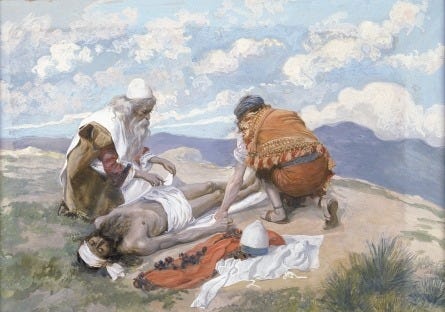
In my essay on Parsha Sh’mini, I proposed Aaron as an exemplar for Eric Auerbach’s conception of a Hebrew Bible archetype, whose “actions are explained not only by what is happening to him at the moment, nor yet only by his character…but by his previous history; he remembers, he is constantly conscious of, what God has promised him and what God has already accomplished for him.” That archetype is opposed to Homeric heroes, “whose destiny is clearly defined and who wake every morning as if it were the first day of their lives: their emotions, though strong, are simple and find expression instantly.” Aaron, I argued, undergoes the most harrowing character transformation in between the lines of the Torah’s events:
The transformations of Old Testament figures, though not explicitly stated, are evidenced by simply comparing where these figures start and their final moments. In Exodus, Aaron is the mouthpiece for Moses, selected by God for his confidence and speech, both of which Moses lacks. By Sh’mini, Aaron is defined by his lack of speech entirely. His “history of personality” is a journey from speech to silence.
This week’s parsha, Parsha Ḥukkat, gives Moses and Aaron’s Auerbachian arc its proper, painful end.
On the journey to Canaan, the promised land that the Israelites will overtake and settle, the Israelites begin complaining of thirst and demanding to return to slavery in Egypt. By now, such complaints are so frequent in the text that they are commonplace. Moses turns to God for help, as he always does. God commands Moses and Aaron to “take the rod and assemble the community, and before their very eyes order the rock to yield its water” (Numbers 20:8). Moses, seemingly exasperated, gathers the community, declaring “Listen, you rebels, shall we get water for you out of this rock?” before twice striking a rock with a staff. Water flows from the rock, the community drinks, and all is well. At least, we think all is well, until God says to Moses and Aaron, “Because you did not trust Me enough to affirm My sanctity in the sight of the Israelite people, therefore you shall not lead this congregation into the land that I have given them” (Numbers 20:12).
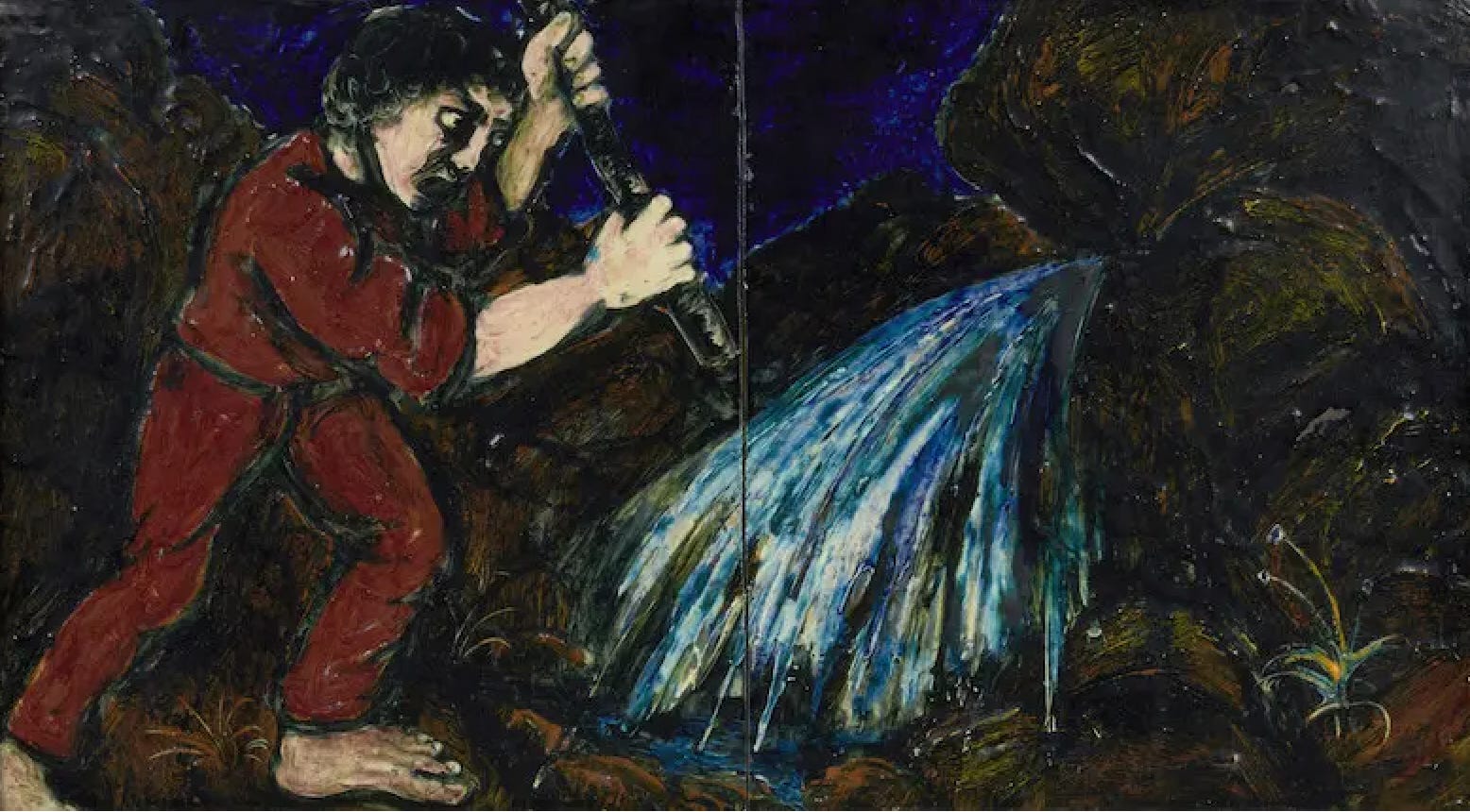
Suddenly, for reasons unclear, Moses and Aaron are condemned to die before the Israelites enter the promised land. Sages and scholars have proposed myriad explanations for Moses’s and Aaron’s sin, so egregious as to warrant their exclusion from the long-awaited destination for which they have given their lives: Moses struck the rock twice instead of just once, betraying his lack of faith in God; Moses’s use of “we” in “shall we get water” indicates that he took credit for God’s miracle; Moses’s harsh words towards the community indicate that he has lost his last shred of patience and is therefore unfit to lead. Another explanation is that Moses has served his purpose in the Jewish project, and entry into Canaan requires a form of leadership he cannot fulfill. Moses’s death is necessary to transfer leadership to Joshua, Moses’s younger, militaristic counterpart.
Moses’s newly revealed fate casts his life in a new light. Over the course of the exodus, Moses has cut himself off from his community and destroyed his relationship with Aaron. After the rock, Moses will not live to see the fruits of his sacrifice, and must question whether God ever intended Moses to see them in the first place. All of the sacrifices were for a destiny Moses was never going to reach himself. Now all Moses can hope for is to salvage what he can with Aaron.
Any such reevaluation, regret, or resolve by Moses is promptly made obsolete when Aaron dies before Moses can act on it. Only shortly after the incident at the rock, God commands Moses to take Aaron up a mountain, where Aaron will die:
Moses did as the Lord had commanded. They ascended Mount Hor in the sight of the community. Moses stripped Aaron of his vestments and put them on Eleazar, and Aaron died there on the summit of the mountain. When Moses and Eleazar came down from the mountain, the whole community knew that Aaron breathed his last. Numbers 20:27-20:2
Like Moses, Aaron dies at the termination of his role in the Jewish project, seeming to drop dead as soon as his robes have been transferred to his son Eleazar. Aaron dies as a priest, and Moses will die as a prophet. Neither will die as a brother.
Moses is ordered to undress Aaron, mirroring the moment in Parsha Tzav when Aaron is first dressed in his priestly robes, also by Moses. This intimate moment is abruptly followed by the brutal deaths of Aaron’s two eldest sons, Nadab and Abihu, by God’s will. It’s unclear whether or not Moses is complicit in their deaths, but his reaction to them is impersonal and cold. When Aaron first dons his priestly garments, his and Aaron’s relationship is on the verge of complete erosion. In Parsha Ḥukkat, around forty years later, Moses undoes the act of dressing Aaron. After one undoing, there are no such reversals for the destruction Moses has wrought to their relationship. Aaron dies; there is no further resolution.
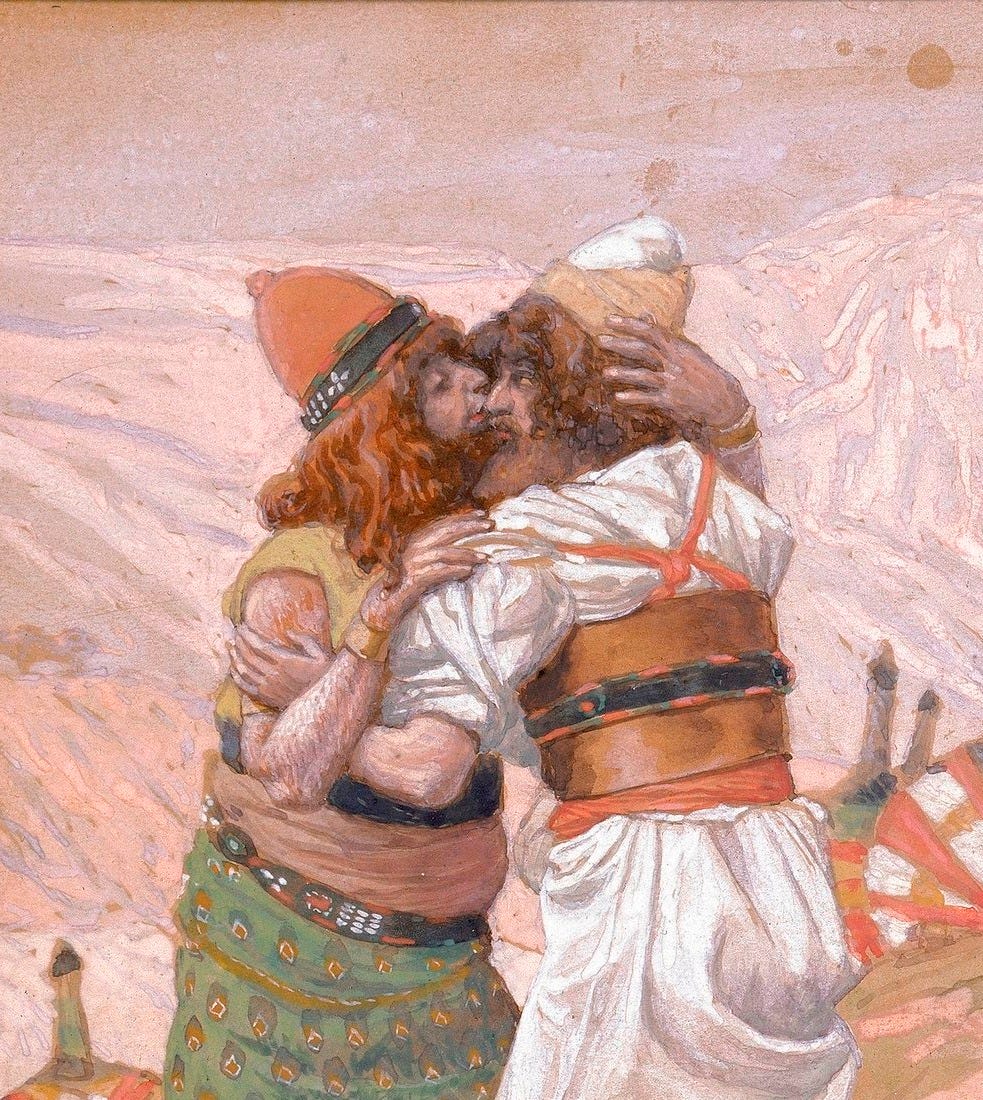
Spliced between the narratives of the rock and Aaron’s death is an episode detailing the Israelites’ struggle to pass through the land of Edom. Edom and the Edomites are the land and descendants of Esau, Jacob’s—Israel’s—brother. The Israelites’ request for safe passage through their brother nation, opening with “Thus says your brother Israel,” is promptly and violently rejected (Numbers 20:14). Jacob and Esau were separated for twenty years after Jacob tricked Esau into giving up his birthright (in an instance of younger sibling/older sibling conflict typical of Genesis), and Esau swore to seek his revenge. Upon reunion, Esau forgives Jacob as the two share an emotional embrace. Edom’s rejection of Israel generations later shows just how much times have changed, and deepens the tragic irony of Aaron’s death. In the post-exodus era shaped by Moses, a reconciliation between brothers that might have been possible in the past has become impossible. Even if Moses wanted to reconcile with Aaron, his own creation disallows it.
Moses is extolled as the greatest prophet who ever lived, in great part because of his selflessness and prescience. At every juncture, he can look past his immediate circumstances and see the bigger picture. It is in Ḥukkat that Moses’ selflessness and prescience are most confirmed for their truth and exposed for their tragedy. Moses, with his far-seeing mind, has looked past and sacrificed his relationship with Aaron. Finally, with no brother and no future in the Holy Land, Moses must look past his own life, identity, and self.
Image: Tissot’s “The Death of Aaron.”