
Mattot—Mas'ei
the end of love

Parsha Mattot recounts a holy war between the Israelites and the Midianites. As a portent of the post-Mosaic era that will follow the Israelites’ entry into the promised land, Moses plays a relatively small role in the crusade. Parsha Mattot hints at another potential factor in Moses’ soon-to-be obsolescence: his mixed marriage.
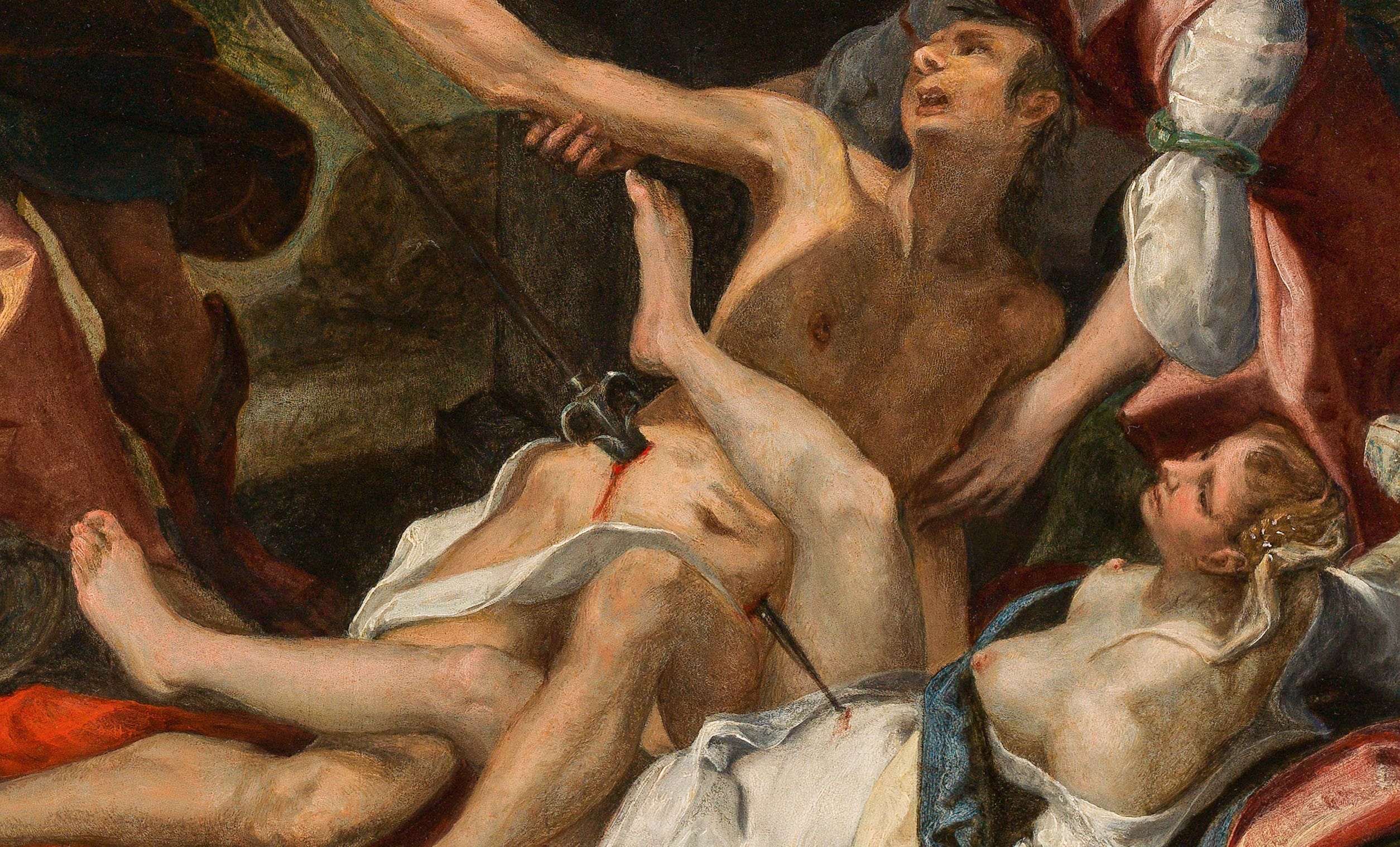
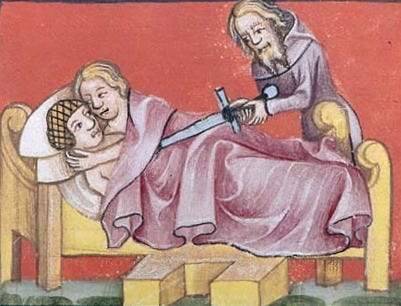
This week, God comes to Moses with His last big command before Moses’ death: “Avenge the Israelite people on the Midianites” (Numbers 30:2). Moses and the Israelites are commanded to wage a war against the Midianites as revenge for an incident detailed in Parsha Balak wherein an Israelite took a Midianite as his wife. (According to the text, the neighboring Midianites and Moabites had seduced Israelite men to get them to worship false gods.) The avenging Israelite army will be headed not by Moses or Joshua, Moses’ successor, but by Aaron’s grandson Phineas, who, upon first sight of the Israelite-Midianite couple, “stabbed both of them, the Israelite and the woman, through the belly” (Numbers 25:7–25:8). Phineas’s fanatical slaughter is not only condoned by God and the text; it is immediately followed by the highest praise as God awards Phineas His “pact of friendship” (Numbers 25:12). It’s no surprise that Phineas would lead the avenging charge against Midian.
Moses plays no part in the war, other than issuing commands (albeit brutal ones) to the tribal leaders under him. More than his old age, Moses’ lack of participation may be due to his deeply personal connection to the tribe of Midian. In the very first parsha of Exodus, in the time of Jewish enslavement under Pharaoh, a young Moses flees from Egypt after impulsively killing an Egyptian taskmaster. As a fugitive, Moses finds asylum with none other than the tribe of Midian; he is welcomed with open arms by the High Priest Jethro and marries Jethro’s daughter Zipporah. Moses even names his first son “Gershom,” meaning “I have been a stranger in a foreign land” (Exodus 2:22).
Jethro goes on to play an unexpectedly significant role in the formation of the covenant and the shaping of Moses’ political model. As I wrote in my essay on Parsha Yitro, which is titled after Moses’ father-in-law:
Jethro is the driving force behind Moses’ decision to seek a covenant, a marriage between the Jews and God, on Mount Sinai. After escaping Egypt, Moses and Jethro reunite. When Moses recounts the exodus to his father-in-law, Jethro is impressed and awed by God’s power. He joins with Moses and Aaron in an offering to God. Jethro is, literally, giving the relationship between the Israelites and God his blessing.
The next day, however, Jethro observes how Moses leads the Israelites. Moses works as a magistrate for every dispute and conflict the people bring before him, no matter how insignificant. Jethro scolds Moses.“You will surely wear yourself out…you cannot do [this] alone” (Exodus 18:18). He advises Moses to share his lesser judicial duties with others, only taking the most important disputes on himself. This will require Moses to ask God for a comprehensive set of rules that the Israelites and lesser judges can refer to in their day-to-day conflicts—the Torah. That the first mention of Torah does not come from an Israelite, or Aaron, or Joshua, or anyone in Moses’ prophetic sphere, but his father-in-law, paints Jethro as a matchmaker. You’ve been dating long enough, Jethro says, you need to put a ring on it. Propose to God.
Even the structure of Parsha Mattot harkens back to the themes of matrimony and in-laws. Just before God’s call for a holy war, He issues a series of commandments detailing a father’s ability to countermand and annul his daughter’s wedding vows.
Phineas’s rise coincides with Moses’ diminution: Parsha Ḥukkat, which concerns Moses’ realization that he will not live to enter the promised land and that his tenure as a leader is concluding, and Parsha Pinḥas, which opens with Phineas’s promotion, are read in direct succession, only a week apart from each other.
In the heyday of Moses’ leadership, his exogamy (the practice of marrying and mating outside of one’s group, as opposed to endogamy) was sanctioned by God and the text. When, in Parsha B’ha•alot’kha, an envious, discontented Aaron and Miriam try to smear Moses for “marrying a Cushite,” God actually intervenes on Moses’ behalf. (Also—read my essay on how the incident relates to psychoanalysis, linked above.) After Phineas, however, mores (even incest taboos) have changed. Tribal exogamy has become intolerable. Why? The Jewish Project is changing. Its scale is increasing. Just as the shift from Genesis to Exodus followed a shift from the family to the tribe, the shift from the Mosaic era to the post-Mosaic era moves from the tribe to the chiefdom—and later, with the rise of King David, the political state.
In Genesis, the Jewish Project was contained within a single family under Abraham. Within societies centered around bands containing one or a few families, exogamy at the band level is necessary to avoid violating the incest taboo. As groups expand to the tribal, chiefdom, and state level, this pressure is relieved; the population and political structure have grown expansive enough that to marry within the group—in this case, the Jewish group—no longer risks incest. Further, by the time the Israelites become a chiefdom, they are preparing for a war that divides enemies along ethnic and tribal lines. In a world where sex and marriage transmit culture, exogamy brings the risk of pagan gods. A kind of endogamous retrenchment, viciously embodied by Phineas, helps the group to its next frontier: the taking of the promised land. The war against Midian is a measure to facilitate the transformation from tribe to chiefdom to state, and with it, a shift from tribal exogamy to endogamy.
In Parsha Ḥukkat, Israel burns its bridges with its brother-nation Edom. In Parsha Mattot, Israel purges its matrimonial bond with Midian. Two histories of love—one fraternal, one affinal—have been blotted out.
Image: “Phinehas slaying Zimri and Kozbi the Midianite,” by Jeremias van Winghe.